Top 5 IT Trends for 2026
Digitalisation in 2026: IT between Innovation, Cost Pressure and Strategic Responsibility
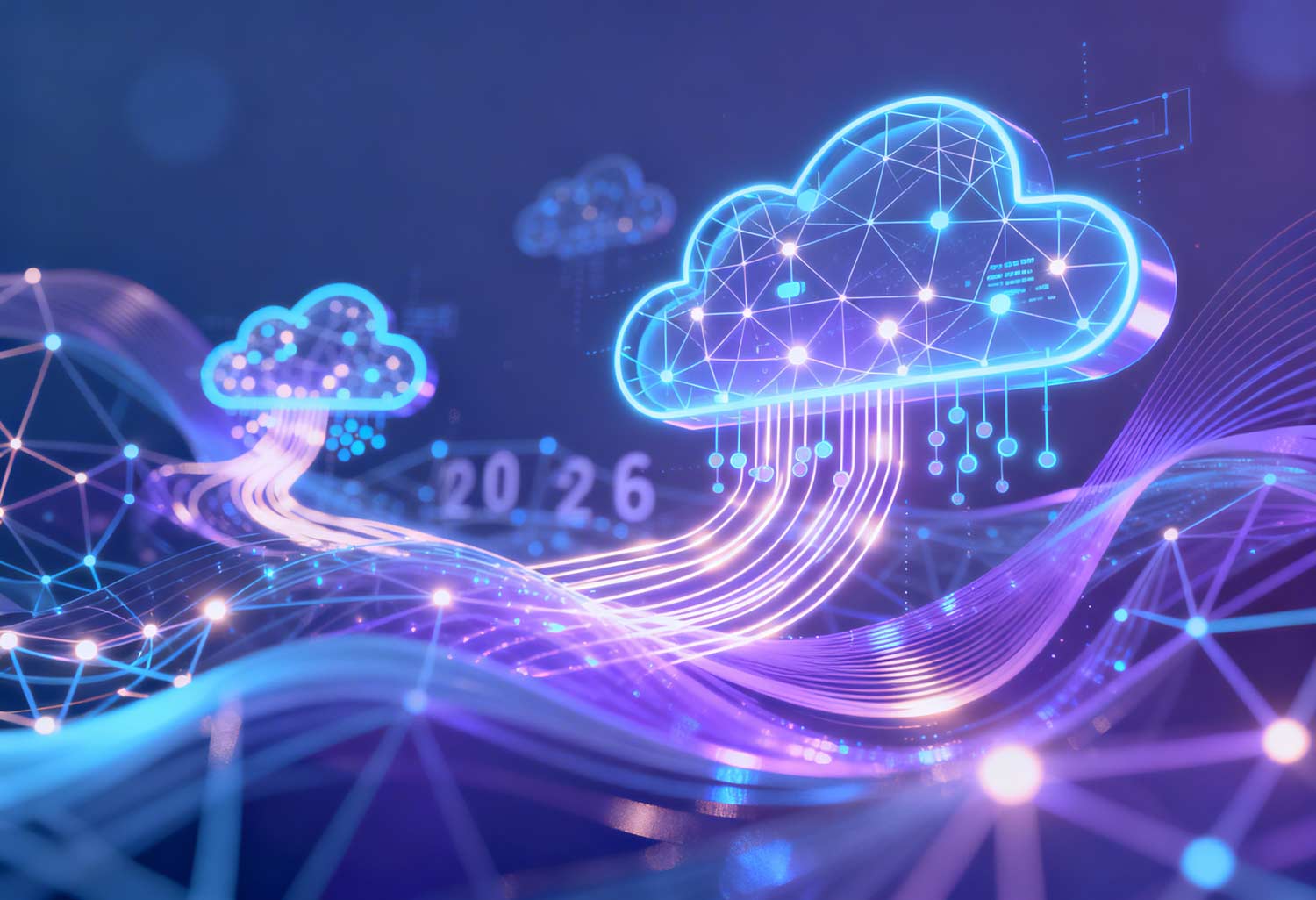
The year 2026 marks a new phase in digitalisation. IT trends are no longer driven primarily by innovation and experimentation, but increasingly by market pressure, cost realities and strategic relevance. Companies must operate their IT environments in a stable, secure and efficient way—while at the same time integrating new technologies.
These five IT trends will shape the agenda of organisations and IT decision-makers in 2026.
1.
Artificial Intelligence (AI) as Core Infrastructure
By 2026, AI is no longer a topic for the future but an integral part of the IT foundation. It is being deployed across almost all areas of business—from automation and data analytics to decision support.
At the same time, AI is transforming the underlying technical infrastructure. Demand for computing power, storage and energy is increasing significantly. IT departments are therefore faced with the challenge not only of introducing AI solutions, but of operating, scaling and governing them sustainably over the long term.
2.
Infrastructure Bottlenecks, Storage Shortages and Rising Hardware Costs
The global expansion of cloud and AI data centres is leading to shortages of key IT resources such as RAM, SSDs, GPUs and networking hardware. The result is rising prices, longer delivery times and significantly higher investment costs.
A major driver of this development is the rapid adoption of AI systems. Modern AI applications require enormous amounts of memory, high-bandwidth memory (HBM), high-performance video memory and fast mass storage. A large share of global memory production is now being absorbed directly by AI and cloud providers, leaving limited availability for traditional enterprise and consumer markets.
This shortage of storage capacity is not a temporary market disruption but a structural consequence of the AI boom. Manufacturers increasingly prioritise highly profitable server and AI memory solutions, while standard components for businesses and end users become scarcer.
As a result, infrastructure planning will become a strategic discipline in 2026. Companies will need to use resources more efficiently, plan storage and hardware requirements well in advance, prioritise investments and deliberately reduce technological dependencies.
The close interconnection between AI, infrastructure and storage availability makes this one of the central IT topics for 2026.
3.
Cybersecurity and Digital Resilience
Cyberattacks continue to increase in both scale and sophistication, becoming more automated and more targeted. At the same time, regulatory requirements and liability risks are rising.
The focus is therefore shifting from pure prevention to resilience: how robust are systems, and how quickly can critical business processes be restored after an incident? IT security is thus becoming an integral component of overall corporate strategy.
4.
Cloud Governance, Cost Control and Digital Sovereignty
Cloud technologies remain essential, but uncontrolled usage can lead to rising costs and new dependencies. In 2026, transparency, governance and compliance will be at the centre of attention.
Multi-cloud and hybrid approaches are gaining importance. At the same time, questions surrounding data sovereignty and regulatory security are becoming increasingly prominent—particularly in regulated industries.
5.
Skills Shortage and the Automation of IT
The shortage of qualified IT professionals continues to intensify, while the demands placed on operations, security and availability keep increasing.
Automation, AI-driven IT operations and standardised processes are becoming crucial levers for maintaining performance despite limited human resources. The role of IT is evolving—from purely operating systems and infrastructure to strategically steering and enabling the business.
Conclusion
The top five IT trends for 2026 clearly demonstrate that IT has become a central success factor for modern organisations. Artificial intelligence, infrastructure, security, cloud governance and automation are closely interconnected and must be addressed holistically.
Companies that tackle these trends early will lay the foundations for stability, competitiveness and sustainable growth in an increasingly demanding digital environment.